A Macro Placement Optimization Framework for Half-Perimeter Wirelength in Very-large-scale integration Design
A Macro Placement Optimization Framework for Half-Perimeter Wirelength and Voltage drop across a resistance in Very-large-scale integration Design
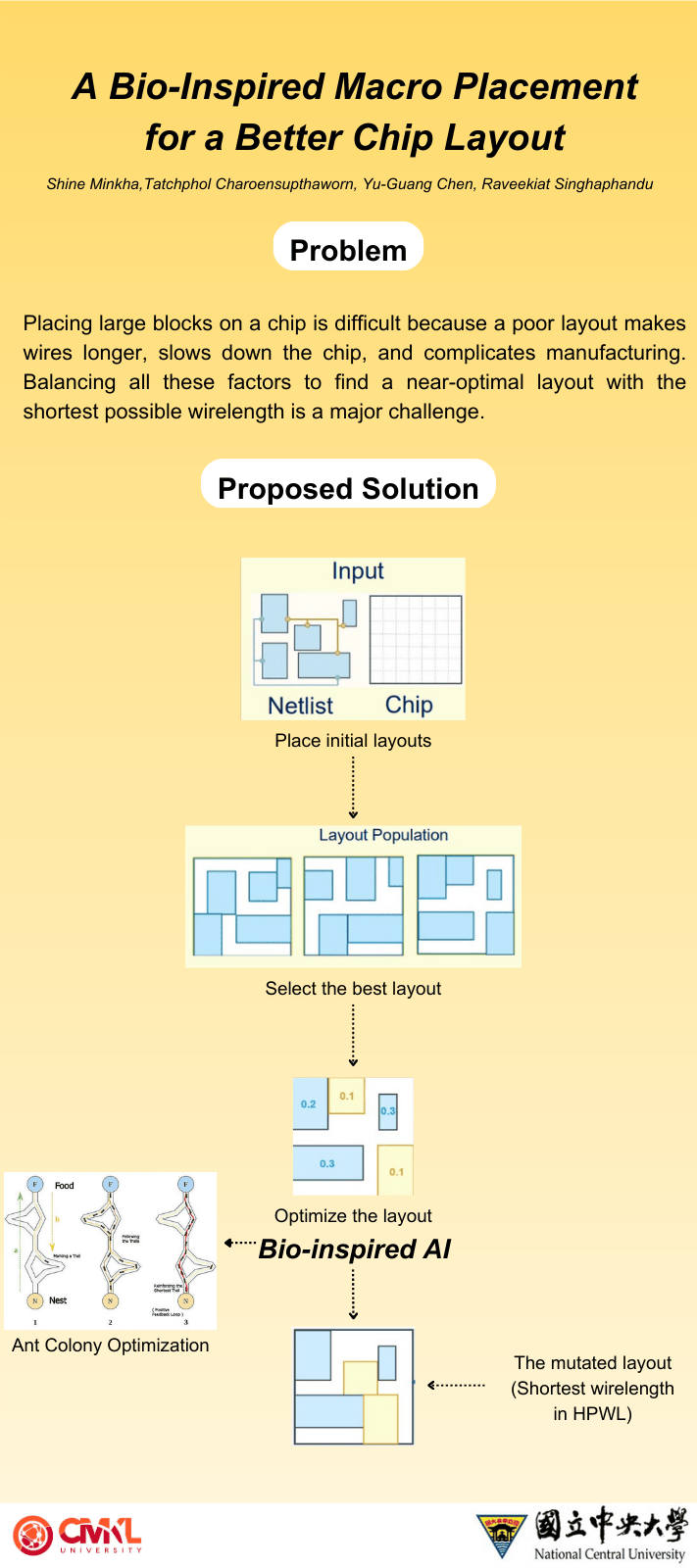
This research proposes a specialized metaheuristic approach to VLSI macro placement, a critical stage in chip design where large functional blocks (macros) are positioned on a silicon die. The primary goal is to minimize the Half-Perimeter Wirelength (HPWL) while ensuring the placement is "legal" (non-overlapping and within boundaries).
The Core Problem: Macro Placement
In modern chip design, macros (like memory banks or IP cores) are significantly larger than standard cells. Their placement determines the efficiency of the entire interconnect network. Poor placement leads to:
Longer Wirelengths: Increasing signal delay and power consumption.
Routing Congestion: Making it impossible to physically connect the components.
Timing Violations: Preventing the chip from running at its intended speed.
The Proposed Solution: Ant Colony Optimization (ACO)
The authors introduce a bio-inspired approach based on how ants find the shortest path to food using pheromones. In this context:
Ants as Placers: Each "ant" constructs a complete placement solution by sequentially assigning macros to grid positions.
Pheromone Matrix: This acts as a collective memory. Positions that result in shorter wirelengths receive higher pheromone concentrations, guiding future ants toward better solutions.
Heuristic Desirability: Ants don't move blindly; they consider the incremental increase in wirelength and proximity to connected macros.
Methodology: How the ACO Placer Works
The framework operates through a hierarchical, iterative process:
Initialization: The chip area is divided into a grid, and design constraints (like fixed blocks) are identified.
Layout Selection: Inspired by the EGPlace framework, the algorithm starts with a pool of candidate layouts generated via greedy strategies to ensure a strong baseline.
Construction & Probabilistic Choice: Ants place macros one by one. The probability of choosing a spot is defined by: $$\text{Probability} \propto (\text{Pheromone Level})^\alpha \times (\text{Heuristic Information})^\beta$$
Local Refinement (Repair): Because stochastic moves can cause overlaps, a "repair" stage shifts or swaps macros to ensure the layout is legal.
Pheromone Update: At the end of a cycle, only the best-performing ants (those with the lowest HPWL) "drop" pheromones on their chosen paths.
Evaporation: Pheromones slowly decay over time, preventing the algorithm from getting stuck in a local optimum (suboptimal solution).
Advantages Over Existing Methods
While analytical placers like DREAMPlace use complex gradient-based math and GPUs, the ACO approach offers:
Global Exploration: Better at searching diverse areas of the placement space compared to purely "greedy" algorithms.
Flexibility: Easily integrates various constraints (non-overlap, legality) into the "cost" of the ant's path.
Pattern Learning: The pheromone system effectively "learns" spatial relationships between heavily interconnected macros.
Future Work and Scalability
The authors identify that while bio-inspired methods are effective, they can be computationally expensive for millions of components. Future enhancements include:
Parallelization (MPACO): Running multiple ant colonies simultaneously on multi-core processors to speed up convergence.
Congestion Awareness: Moving beyond just wirelength to consider how "crowded" the routing channels become.
Hybridization: Combining ACO’s global search with analytical techniques for fine-tuned, local optimization.
.jpg)
.png)
.png)


