Agentic AI for Multi-Source PM2.5 Pollution Analysis and Location-Based Mitigation Strategies: A Case Study in Thailand and Japan
Introduction
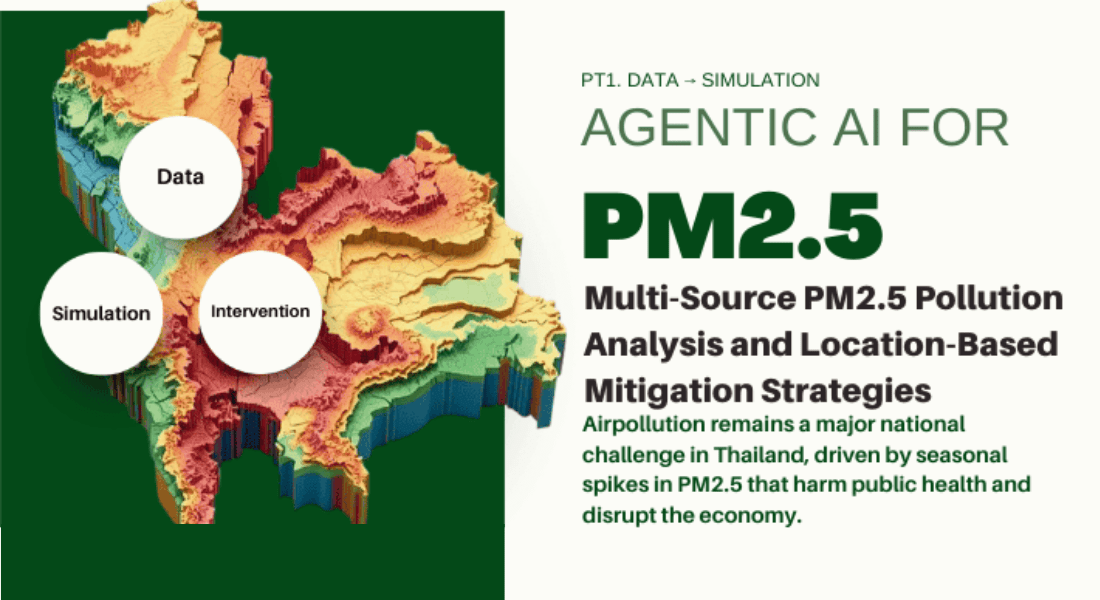
The Problem: Seasonal Haze in Northern Thailand
Provinces like Chiang Mai and Mae Hong Son face extreme $PM_{2.5}$ levels, often exceeding $200\text{–}300\mu g/m^3$ during the burning season (January–April). This leads to a 20–30% spike in hospital admissions for respiratory issues. Existing forecasting systems are hindered by sparse monitoring networks and a lack of physical grounding, often failing to provide actionable early warnings.
The Solution: An Integrated AI Playground
This project delivers an interactive environment that performs two critical tasks:
Forward Forecasting: Predicting $PM_{2.5}$ levels one hour ahead on a spatial grid.
Inverse Source Identification: Tracing predicted pollution back to specific origins like hotspots, factories, or cross-border smoke.
Key Features
Hybrid SVR-PICNN Architecture: Combines Support Vector Regression (SVR) for temporal trends with Physics-Informed Convolutional Neural Networks (PICNN) for spatial accuracy.
Physics-Informed Constraints: The model enforces the Advection–Diffusion–Reaction (ADR) equation, ensuring predictions follow the laws of atmospheric physics.
Inverse Source Search: Utilizes DeepONet and Graph Attention Networks (GAT) to discover hidden emission sources from sparse sensor data.
Multi-Source Data Pipeline: Integrates hourly $PM_{2.5}$ measurements, NASA FIRMS fire hotspots, factory inventories (DIW), and vehicle statistics (DLT).
Robust Data Imputation: Employs PCHIP and linear interpolation to maintain a continuous hourly data stream despite sensor outages.
Development and Innovation
The framework is built on a "Forward-Reverse" dual engine that balances raw data with physical reality.
1. Forward Forecasting (The Predictive Engine)
The system uses a parallel model structure:
SVR Component: Handles the coarse-grained time-series prediction of $PM_{2.5}$ concentrations.
PICNN Component: Refines the spatial distribution. Because it is "physics-informed," it penalizes predictions that violate the ADR equation, which describes how pollutants move (advection) and spread (diffusion).
2. Inverse Modeling (The Forensic Engine)
To identify where pollution comes from, the team introduced a DeepONet Graph Attention PINN.
Graph Neural Networks (GNN): Ideal for Thailand's irregular monitoring network, where stations are scattered unevenly.
DeepONet: Maps input functions (like wind fields) to output functions (concentration maps), allowing the system to generalize across different weather scenarios without retraining.
Results and Impact
Performance Validation
Experiments using real-world data from nine monitoring stations revealed that the parallel architecture (SVR and PICNN running in tandem) achieved the strongest predictive performance. By enforcing physical continuity, the model remains stable even when ground-sensor data is noisy or missing.
Future Directions
The framework establishes a foundation for:
Policy Simulation: Testing how "what-if" scenarios (e.g., a 50% reduction in farm burning) would impact air quality.
Real-Time Warnings: Providing high-resolution maps for public health alerts.
Source Attribution: Offering transparent data to stakeholders regarding industrial vs. agricultural contributions to haze.


.png)
.png)