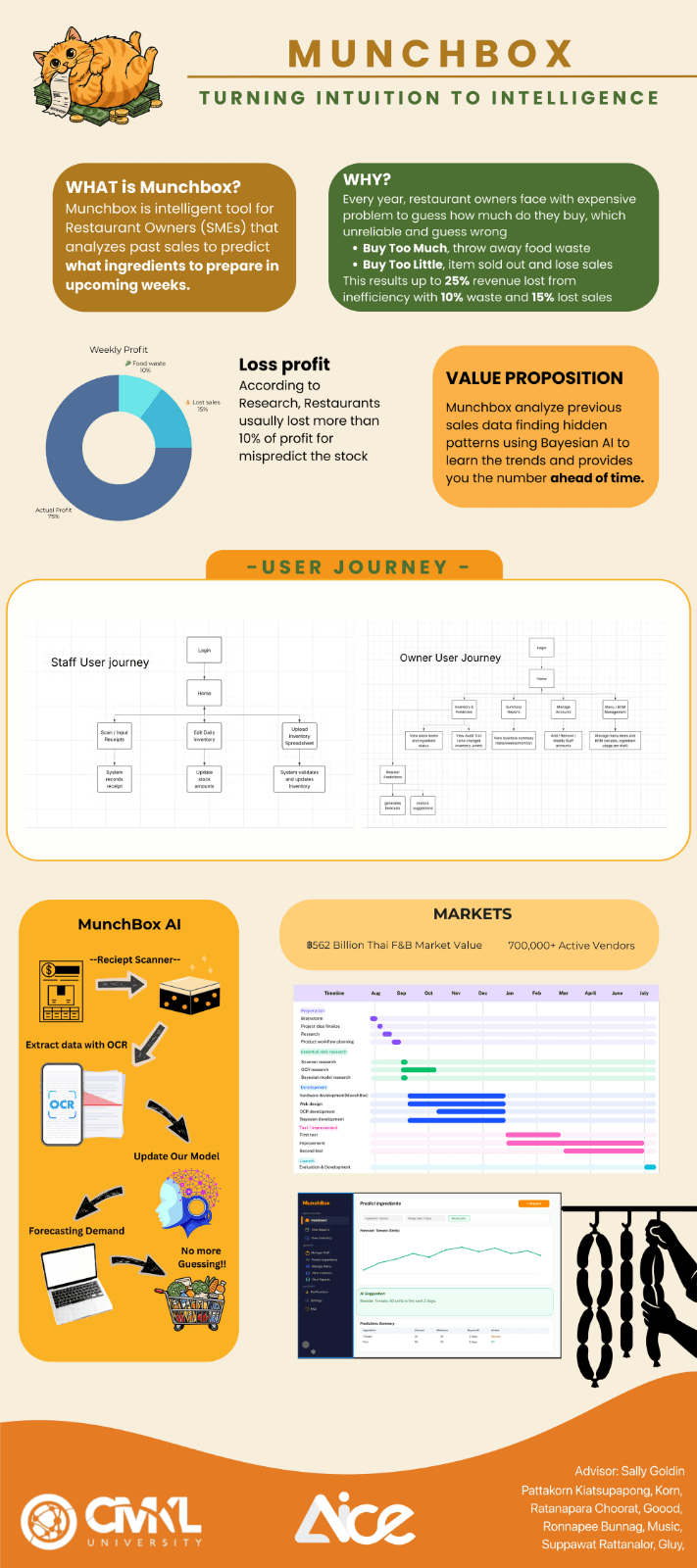
MunchBox: Optimizing restaurant inventory using AI
Introduction
MunchBox is an intelligent, AI-driven inventory optimization system designed specifically for small and mid-sized restaurants. In an industry where up to 30% of weekly profits vanish due to preparation mistakes—either through lost sales from stockouts or food waste from overstocking—MunchBox replaces traditional guesswork with data-driven precision.
Unlike standard POS systems that merely record the past, MunchBox is a forward-looking "tech layer" that plugs into existing setups to forecast future demand. By digitizing paper receipts and applying advanced probabilistic modeling, MunchBox helps restaurant owners cut waste, maximize profit margins, and maintain a perfectly stocked kitchen.
Key Features
Predictive Inventory Forecasting: Uses a Bayesian structural model to move beyond fixed numbers, providing a "range of risk" for future ingredient needs.
Physical Receipt Scanner: A custom-built hardware prototype that digitizes paper records automatically, saving staff from hours of manual data entry.
Intelligent OCR Pipeline: Powered by PaddleOCR, the system converts raw images of receipts into usable digital data with high accuracy.
Local & Secure Processing: Everything runs on-site within the restaurant’s own hardware (Raspberry Pi 5). Your sensitive sales data never leaves the building.
Web-Based Management Dashboard: A user-friendly interface that transforms complex statistical data into clear, actionable charts and recommended order lists.
Development and Innovation
The innovation of MunchBox lies in its "brain"—a sophisticated Bayesian Forecasting Model combined with economic optimization logic.
The Forecasting Engine
MunchBox utilizes Bayesian Structural Time Series (BSTS) to decompose sales data into three core pillars:
Baseline: The average demand for an ingredient.
Seasonality: Weekly effects, such as the predictable "weekend boost" in customer traffic.
Noise: Unpredictable real-world volatility that the model accounts for as uncertainty.
Economic Optimization (The Newsvendor Problem)
Rather than just predicting a median value, the system applies the Newsvendor framework to determine the optimal order quantity ($Q^*$). It balances the Cost of Overage (spoilage) against the Cost of Underage (lost profit), allowing owners to choose a strategy:
Aggressive: High availability for high-profit items.
Conservative: Minimized waste for expensive or highly perishable goods.
Impact and Future Directions
MunchBox aims to bridge the digital divide for restaurants that still rely on traditional paper-based workflows. By converting a static picture of a receipt into a profit-maximizing decision, the system provides "private-bank-level" logistics intelligence at an affordable scale.
Future Goals Include:
Cloud-Hybrid Integration: While maintaining local privacy, offering optional encrypted cloud backups for multi-location restaurant groups.
Enhanced Recipe Intelligence: Expanding the Bill of Materials (BOM) database to automatically calculate granular ingredient needs (e.g., grams of chicken per dish) across diverse menus.
Predictive Weather Integration: Incorporating external factors like local weather forecasts into the Bayesian "Prior" to adjust for rainy days or heatwaves that impact customer behavior.