Pose-to-Production: Animation Transfer from Pose Estimation to Mocap Skeletons
Pose-to-Production: Animation Transfer from Pose Estimation to Mocap Skeletons
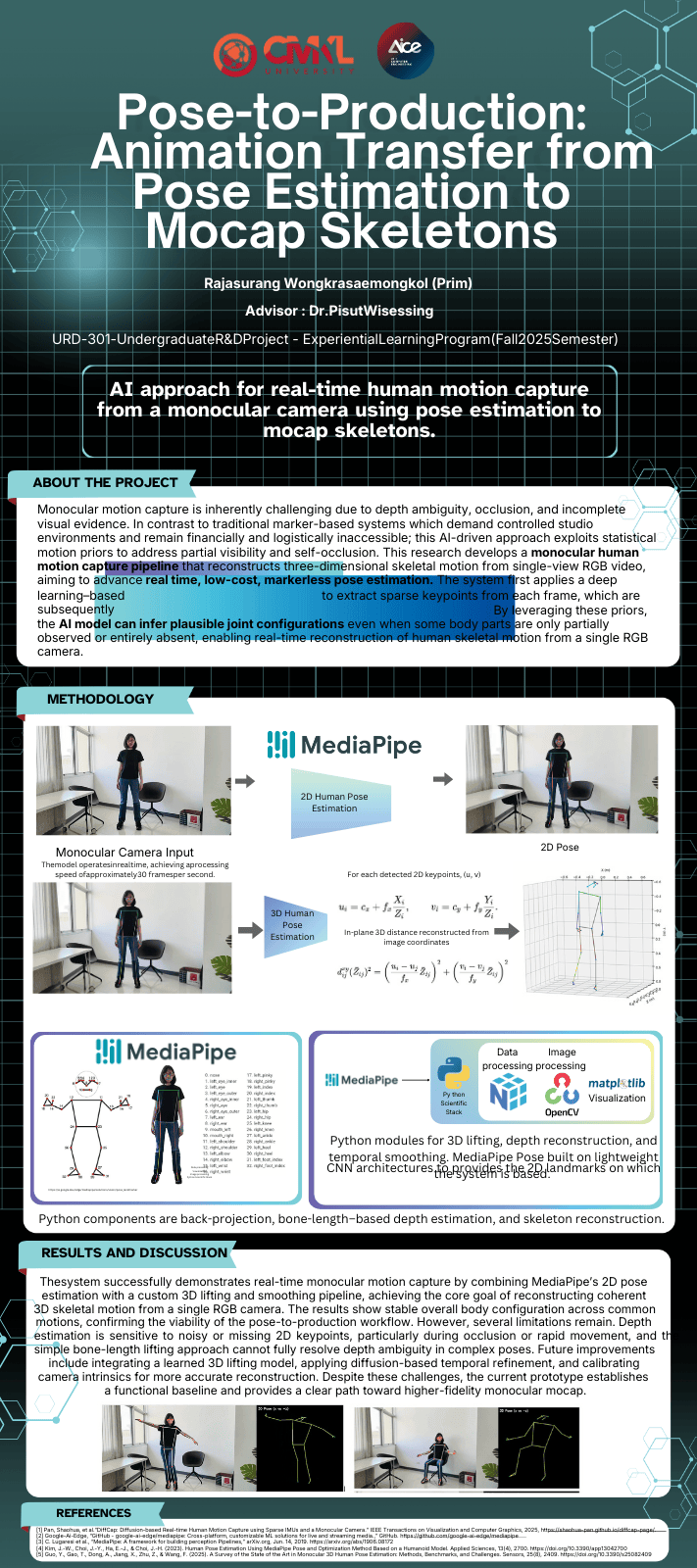
This project focuses on transitioning from expensive, hardware-heavy motion capture (mocap) to an AI-driven monocular RGB system. By using a single standard camera and deep learning, the goal is to democratize high-fidelity animation for independent creators and researchers.
The Problem: Accessibility vs. Accuracy
Traditional mocap systems are the gold standard for precision but suffer from high barriers to entry:
Optical Systems: Use infrared cameras and reflective markers. They are precise but cost thousands of dollars and require controlled studio lighting.
Inertial Suits: Use IMU sensors (gyroscopes/accelerometers). They are portable but suffer from "drift" over time and can be physically cumbersome.
Monocular Challenges: Single-camera systems often struggle with depth ambiguity (not knowing how far an object is) and self-occlusion (when a limb hides another limb).
Technical Foundation: Kinematics and Estimation
To turn a 2D video into a 3D skeleton, the system relies on two mathematical frameworks:
Forward Kinematics (FK): Calculating the position of the hand based on the angles of the shoulder and elbow.
Inverse Kinematics (IK): Calculating what the shoulder and elbow angles must be to reach a specific hand position. This is crucial for "grounding" feet so they don't slide through the floor.
Human Pose Estimation (HPE): Using tools like MediaPipe or OpenPose to identify 2D keypoints (shoulders, knees, etc.) on a flat image.
The Solution Architecture
The project implements a real-time pipeline that "lifts" 2D data into 3D space:
Detection: MediaPipe extracts 2D landmarks from the RGB feed.
3D Lifting: A neural network uses statistical motion priors to guess the 3D coordinates. If a leg is occluded, the AI "infers" its position based on how humans typically move.
Retargeting: The 3D coordinates are mapped onto a digital "rig" (like the SMPL-X body model) so it can be used in software like Blender.
Advanced Hybrid Methods (Related Works)
The research explores cutting-edge ways to solve the "occlusion" problem found in single-camera setups:
RobustCap & DiffCap: These systems combine a single camera with a few "sparse" IMU sensors (e.g., just on the wrists and ankles).
Diffusion Models: Similar to how AI generates images, DiffCap uses diffusion to "denoise" a pose, turning a jittery, occluded estimate into a smooth, anatomically correct movement.
MeshRet: A method that looks at the "skin" (mesh) of a character rather than just the "bones" to prevent limbs from clipping through the body during retargeting.
Summary of Project Objectives
Real-time Inference: Generating 3D motion at 30-60 FPS for live applications.
Occlusion Handling: Using AI to "see" through hidden limbs.
Blender Integration: Exporting data to .BVH or armature formats for immediate animation use.


.jpg)
.png)


