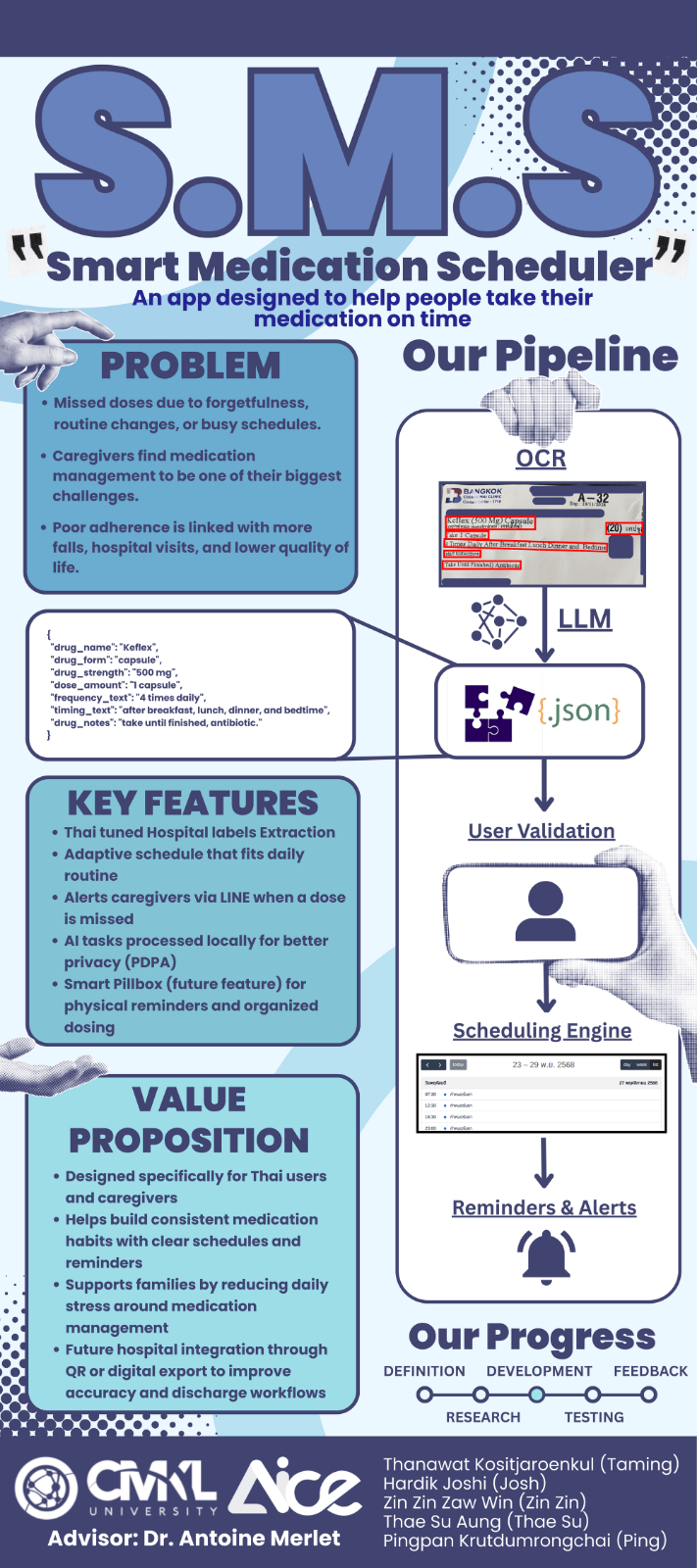
The Smart Medication Scheduler (S.M.S.) is an AI-driven solution designed to solve the critical challenge of medication adherence in Thailand. Research indicates that over one-third of Thai patients struggle with poor adherence, leading to increased risks of falls and hospitalizations.
Traditional global apps fail in the local context because they cannot interpret the unique plastic bag labels used by Thai hospitals. S.M.S. bridges this gap by offering a locally adapted tool that reads Thai and English instructions, reducing the manual workload for patients and caregivers while improving safety through automated, clear scheduling.
Key Features
AI-Powered Thai OCR: Uses advanced Optical Character Recognition to extract text from complex, multi-language hospital labels, even in sub-optimal lighting or curved surfaces.
Instruction Interpretation: Employs Large Language Models (LLMs) to convert unstructured Thai phrases (e.g., "รับประทานครั้งละ 1 เม็ด หลังอาหาร") into a structured digital format.
Adaptive Scheduling: A smart engine that aligns medication times with the user’s personal habits (eating and sleeping) rather than forcing a generic schedule.
Caregiver Support: Integrated alerts via LINE notify family members if repeated doses are missed, providing a safety net for elderly users.
Privacy-First Design: Prioritizes on-device processing to ensure sensitive medical data remains on the user's smartphone, maintaining compliance with Thailand’s PDPA.
Development and Innovation
The S.M.S. project represents a technical breakthrough in combining computer vision with linguistic reasoning:
The Technical Pipeline
Digital Preprocessing: Uses OpenCV for image denoising, deskewing, and contrast adjustment to ensure the highest quality input for text extraction.
Multilingual Extraction: Utilizes EasyOCR, a deep-learning model capable of recognizing the complex tone marks and vowel placements unique to the Thai alphabet.
Semantic Mapping: Powered by the Qwen-3-4B-Instruct model, the system interprets the extracted text using "attention" mechanisms to identify dosage, frequency, and specific warnings.
Local Data Management: Uses Dexie and Luxon for high-performance, offline-capable storage and timezone-aware scheduling logic.
Impact and Future Directions
By automating the transition from a physical label to a digital reminder, S.M.S. significantly reduces the "cognitive load" on elderly patients and reduces errors caused by manual data entry.
The Roadmap for S.M.S. includes:
Hardware Integration: Connecting the app to an affordable Smart Pillbox for physical sensory reminders.
Advanced Safety Checks: Integrating the DrugBank dataset to provide automated checks for drug interactions and clinical safety warnings.
Pattern Recognition: Enhancing the adaptive scheduler to detect behavioral patterns (like consistent snoozing) and proactively suggesting more convenient medication windows.
.png)