PROGRAM

B.Eng. in AiCE Degree Requirements

Overview

AiCE students must satisfy multiple requirements before the Bachelor of Engineering degree is certified.

  1. They must earn a minimum of 360 credit units in total. (The maximum allowed is 400.)
  2. The credits they earn must satisfy distribution limits. Specifically, they must earn at least 62 unitsof arts, humanities, social science and communication electives; 90 units of math/science; 136 unitsof core technical fundamentals; 38 units of undergraduate research and development outside of XP; and 30 units of experiential learning (XP) including a 12 credit capstone project.
  3. They must complete all required competencies.
  4. They must receive an average grade of at least C for soft skills across their first four semesters.All requirements are expressed via the AiCE competency scheme. Some competencies are required,meaning that every AiCE student must demonstrate this competency in order to graduate. Others areoptional. In some cases, optional competencies form a set from which the student is required to select asubset to complete.

Because of the individualized nature of the AiCE program, the pattern of study for each student willbe different. Furthermore, students who receive credit upon entry to the program because of advancedplacement courses or other prior experience will experience a different learning path than students withoutthese pre-existing skills.

The section below entitled AiCE Competencies presents the full set of currently defined competenciesand the amount of credit associated with each one, with an indication of whether the competency is required in order to graduate. We expect that this information will change somewhat over time as wedevelop new academic specialties and adapt to new technology developments

Undergraduate Research and Development

The AiCE program is designed to provide students with opportunities to solve real world problems in collaboration with external stakeholders from industry, government and/or non-governmental organizations, both domestically and overseas. Starting in their first semester, students will devote at least 7-9 hours per week working on projects in three tracks:

  • Entrepreneurship and Innovation;
  • AI for Society; and
  • Experiential Learning Program (XP)

We call this project work “Undergraduate R&D”, though depending on the project, the work may tend more toward research or more toward development. The students are expected to participate for at least two semesters (18 credits) in each track. AiCE students must complete all three tracks to satisfy their graduation requirement. Expected output from the completion of each of these project tracks is comparable to completing a capstone design project. Hence AiCE graduates will have significantly more real-world research and development experience than students who earn bachelor’s degrees from most other computer engineering programs.

The projects will be designed by the organizational stakeholders in collaboration with CMKL University faculty; however, students will be encouraged to provide input and suggestions. If they have some original ideas they would like to pursue, students can also propose their own project topics to potential stakeholder organizations.

Once the scope and high-level problem for a project has been defined, the CMKL faculty will map the project to a set of associated competencies, based on the knowledge and skills that the project requires. These competencies may be either required or optional competencies. Thus, project work may overlap with more traditional study activities in satisfying the graduation requirements.

Credit for undergraduate R&D work will depend on the underlying competencies. Even if a project specifies a competency that the student has already demonstrated via more traditional study activities, the student can receive additional credit for this competency. This recognizes the fact that the level of mastery required by a real-world project will usually be higher than necessary to pass the initial competency assessment.

Each research project will be mapped to a set of associated competencies (typically three or four), based on the knowledge and skills the project requires. For first year projects, these will be required, core competencies such as Introduction to Programming, Supervised and Unsupervised Learning, etc.

Advisors will assess students on their overall performance in the project, considering effort, productivity, time management, teamwork, communication, and similar professional skills. In addition, project team members will receive scores for each of the associated competencies. This score will reflect the students’ ability to successfully integrate the knowledge and skills from the competency into the project work and will be independent of the project-level assessment.

Experiential Learning Program (XP)

The Experiential Learning Program (XP) is a core feature of the AiCE program. It is designed to foster students’ personal and professional growth through learning activities conducted outside the classroom. By engaging with stakeholders outside the university and applying their knowledge and creativity to real-world research and application problems, students have the opportunity to develop advanced skills while enhancing their credentials for future employment.

XP is open to AiCE students who have successfully completed their sophomore year and have earned a minimum of 180 competency credits.

The program encompasses the period from the summer of sophomore year through the spring of senior year. Upon successful completion, students can earn 9-18 XP credits for each fall or spring semester and 9 of XP credits for each summer. Every AiCE student must earn at least 18 XP credits in order to graduate.

Students involved in XP will engage in various activities as described below. A student can do all activities, during different semesters.

  1. International Study/Research: Students have the opportunity to study or work on research at overseas educational or research institutions. These experiences provide hands-on learning, cultural immersion, and global networking opportunities. To be eligible for an international placement, students must maintain a minimum 3.0 GPA. Non-native English speakers may need to meet language proficiency requirements specified by host universities. Students are responsible for covering expenses such as accommodation, meals, travel, and incidentals.
  2. Industrial Internship Program: Our robust industrial internship program offers students a unique opportunity to gain invaluable real-world experience and forge crucial industry connections. Engaging in intensive internships with our esteemed industrial partners including top tech corporations, students acquire practical insights and hands-on skills essential for their professional development. During their participation in this program, students are expected to cover expenses such as accommodation, meals, travel, and incidentals.
  3. Collaborative AI Tech R&D: The Collaborative AI Tech R&D program allows undergraduate students to engage in cutting-edge research on artificial intelligence-related topics. Through partnerships with the AI Engineering Institute and international collaborators, students gain practical skills and research experience. Opportunities may include co-authoring publications or patents.

All of these activities are expected to complement formal coursework and to provide students with valuable experiences to enhance their academic and professional development.

AiCE Competencies
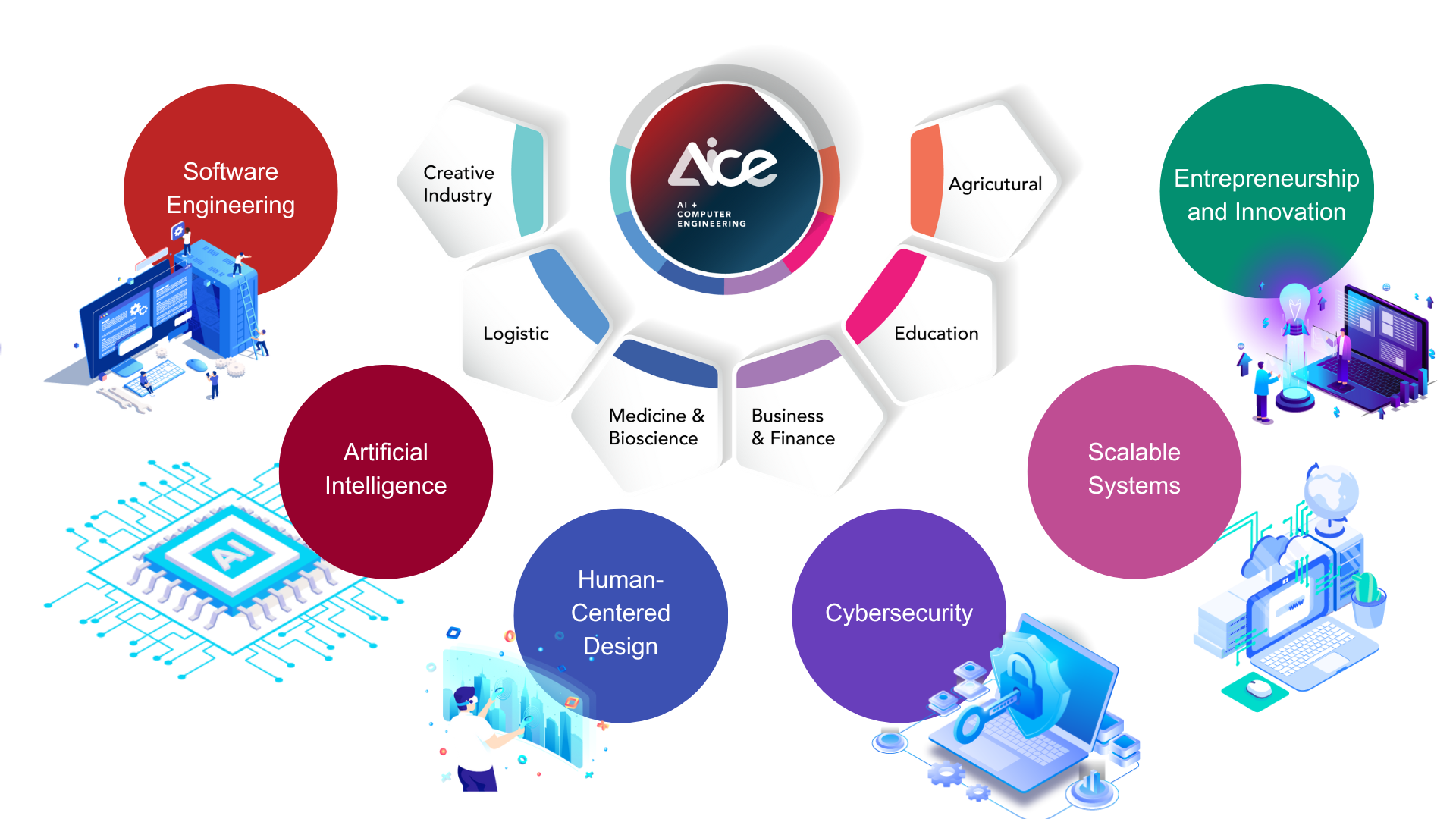
The AiCE competencies are organized according to knowledge pillars. Each pillar represents a broad set of topics and concerns. There are six core pillars in the program: Software Engineering,  Artificial Intelligence, Human-Centered Design, Cybersecurity, Scalable Systems and Entrepreneurship and Innovation. In many cases these major categories are divided into subcategories called knowledge subdomains.

In addition to these central pillars, we also incorporate science, mathematics, humanities, and other competencies, which would normally be viewed as external electives or general education, into our scheme. Additional competencies may be available through AIEI university network and student can request for competency credit transfer through AIEI system.

The tables below list the currently defined competencies for each pillar. We expect to define additional competencies in the future.

Pillar:

Artificial Intelligence

Total credits:

86

; Required:

14

(choose 1 AI Applications)

Subdomain

Code

Competency

Credits

Required?

*Students must complete at least one AI Application competency. This may be in the context of undergraduate R D.

Pillar:

Communication and Presentation

Total credits:

56

; Required:

10

Subdomain

Code

Competency

Credits

Required?

Pillar:

Cybersecurity

Total credits:

42

; Required:

8

Subdomain

Code

Competency

Credits

Required?

Pillar:

Entrepreneurship and Innovation

Total credits:

104

; Required:

8

Subdomain

Code

Competency

Credits

Required?

**Students need to choose one of these application domains to satisfy ENI pillar requirements. The list of business application domains may be expanded. **Competencies can be counted toward math and science requirements. Other scientific application domains proposed by students or stakeholders may also provide math/science credits.

Pillar:

Human-Centered Design

Total credits:

154

; Required:

8

Subdomain

Code

Competency

Credits

Required?

Pillar:

Humanities Arts and Social Sciences

Total credits:

93

; Required:

0

Subdomain

Code

Competency

Credits

Required?

Pillar:

Mathematics

Total credits:

76

; Required:

48

Subdomain

Code

Competency

Credits

Required?

*Students must complete a total of 90 credits of math and science competencies. This includes 48 required credits of the Mathematics for Al competencies as well as some other designated competencies within the six main pillars.

Pillar:

Scalable Systems

Total credits:

54

; Required:

12

Subdomain

Code

Competency

Credits

Required?

Pillar:

Science

Total credits:

60

; Required:

0

Subdomain

Code

Competency

Credits

Required?

*Students must complete a total of 90 credits of math and science competencies.

Pillar:

Soft Skills

Students do not sign up for the competencies under the “soft skills” pillar. However, all students arerequired to demonstrate these competencies during their undergraduate career. Usually, soft skills will beevaluated by instructors or industry mentors as part of the student’s work on projects or undergraduateR&D. Students are required to achieve a minimum of “Apprentice” level of mastery in all soft skillscompetencies to be eligible for graduation.To facilitate this evaluation, the full AiCE curriculum model breaks down each of these soft skill com-petencies into a set of observable behaviors that will allow objective assessment of the degree to whichthe students demonstrate these competencies

Subdomain

Code

Competency

Credits

Required?

Students are required to achieve a minimum of 'Apprentice' level of mastery in all soft skills competencies to be eligible for graduation.

Pillar:

Software Engineering

Total credits:

102

; Required:

22

Subdomain

Code

Competency

Credits

Required?

Pillar:

URD Undergraduate Research Development and Practice

Total credits:

152

; Required:

68

Subdomain

Code

Competency

Credits

Required?

*To be eligible for the XP competencies enrollment, AiCE students must have completed their sophomore year and earned at least 180 credits. AiCE students must earn at least 18 XP credits. **URD-401 and URD-402 are intended for AiCE students who are planning to continue to graduate studies. ***URD-411 is required for CIE-AiCE Dual Degree program students.

Three-year Accelerated Study Plan

AP/ IB / A-Level Credit Awarding Guidelines

Learn more

Integrated Master and Bachelor Degree Program (IMB)

Learn More

Questions?

If you have any questions, do not hesitate to contact us.

By inquiry form
General program inquiry form